In 2026, Augmented Reality (AR) advertising has moved beyond the "wow factor" of experimental activations to become a high-performance, mainstream channel.
For modern brands, Augmented Reality is the ultimate bridge, connecting physical products to digital experiences.
We’ve written this guide so you can understand the best ways to leverage Augmented Reality in your marketing mix in 2026.
With more that 30,000 AR experiences for leading brands under our belt at Blipparstudios we’re help brands captivate audiences with award winning augmented reality experiences.
What this guide covers:
What is Augmented Reality Advertising?
Why Brands are looking to AR in 2026
How to use AR across the marketing funnel
Examples of AR campaigns driving engagement
Technology choices for AR in 2026
Planning and measuring ROI in AR campaigns
AR’s role in sustainable advertising
How the AR landscape is evolving
Frequently asked questions
Firstly, what is Augmented Reality Advertising?
At its core, AR advertising is a digital format that overlays interactive, computer-generated content, 3D models, spatial audio, and real-time data onto a user’s physical environment. In practice that means putting your brand experience in the consumers' hands and eyes in the real world. It means they can interact and experience your brand on their devices and in the environments they’re familiar with.
Unlike Virtual Reality (VR), which isolates the user in a digital bubble, AR enhances reality. It allows a brand to sit on a user’s coffee table, stand in their garden, delight them from the supermarket shelves or live on their product packaging, resulting in 45% higher attention levels than TV viewing or online browsing.
The Defining DNA of AR in 2026
Truly Interactive: This isn't passive viewing. Users move, touch, and orient digital objects within their own space. Great AR experiences often use gamification, interaction with celebrities or brand partnerships to deliver experiences that simply aren’t possible on traditional platforms.
Context-Aware: Experiences now adapt. They can know if it’s raining, what time of day it is, or if a user is standing in a specific retail aisle.
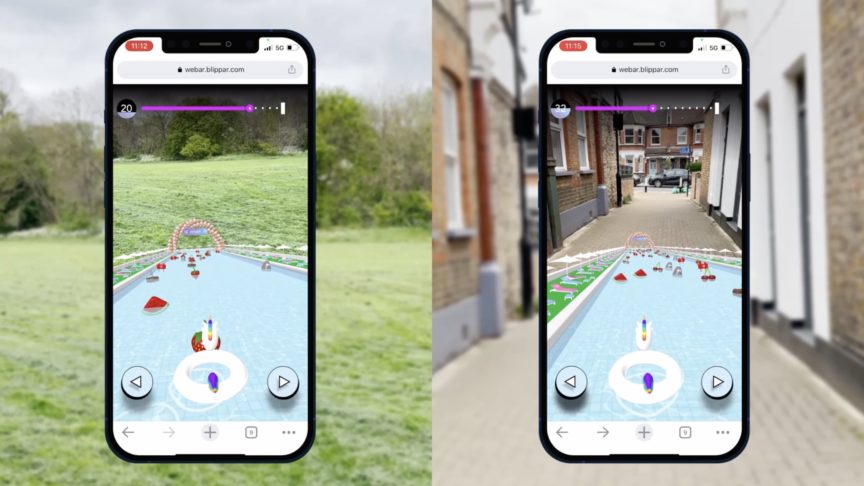
Frictionless Accessibility: With the prevelence of WebAR technology from providers like Blippar, the "download an app" barrier is removed. If you have a browser, you have AR. (Of course, we’ll also explore what 2026 looks like for App based AR experiences in this guide)
Precision Measurement: Every interaction, from how long someone "held" a virtual product to where they placed it in their room, is trackable data. Great AR advertising campaigns don’t just drive engagement and conversions, they perfectly suited to clear measurable KPIs.
Why Brands are looking to AR in 2026
Marketing in 2026 is a battle for attention. Traditional ad campaigns, particularly on social platforms are often seen as interruptions. By contrast, Augmented Reality is seen as an experience.
Breaking the "Attention Recession": While social video ads struggle to hold attention for 6 seconds, Blippar-powered AR campaigns consistently see users engaging for 2 to 4 minutes.
Eliminating Purchase Regret: High-consideration categories (furniture, automotive, luxury) use AR to provide "spatial proof." When a user sees a product at scale in their own home, the "will it fit?" anxiety vanishes.
The Memory Multiplier: Neuro-marketing studies show that AR experiences trigger significantly higher brand recall than 2D video. We don't just remember what we saw; we remember what we did.
How AR is works across the 2026 marketing funnel
AR is no longer just a "top-of-funnel" brand awareness strategy. It is a full-funnel workhorse that delivers engaging experiences for consumers at every step.
Social & Creator-Led AR: Influencers now drop 3D product "portals" into their feeds, blending social proof with interactive demos. Blippar created an AR experience that teleported NFL star Tony Romo into the user’s home, where he delivered a personalised, motivational “Romo-tivation” session. Users could interact with the Corona’s ‘Gameday Goodlife’ experience, customise their virtual game-day environment, and win prizes. Combining social proof with immersive brand storytelling.
Retail & Commerce Integration: AR can be integrated into more steps of discovery and buying cycle. In ecommerce for example product detail pages (PDPs). The "View in Room" button is becoming more common. While fashion brands also continue to explore AR experiences for try on and trend suggestions. Something we’re likely to see more frequently in 2026.
Connected Packaging: Every box, bottle, and bag is now a digital media channel. By scanning a QR code, brands turn physical waste into an interactive loyalty platform. Our case studies are a rich example of this in action. **Coke prem experience example… how you can get much more engagement from
Brands advertising with AR powered immersive experiences see 90% higher engagement than equivalent non-AR experiences.*
Examples of how brands are driving engagement with AR advertising campaigns.
Timberland - GreenStride: When a physical launch wasn't viable, Timberland used AR to let customers explore footwear in 3D. The result? 6× average interactions per visit and a 4-minute dwell time.
This was AR used to communicate complex product stories and a strong alignment with sustainability messaging
OnePlus - NORD Live Launch: Replaced a physical event with an AR experience, reaching 7 million viewers in 26 minutes and driving 4 million device sales in the first week. Became Amazon India’s most successful phone launch It’s a great example of AR advertising driving a direct commercial outcome with immersive product storytelling. AR Product Launch world first.
LEGO - Insiders Treasure Hunt: A global WebAR campaign reaching 85,000 peak daily visits with an average dwell time of 2:33, proving AR sustains engagement over time. Lego Insiders
Accessible in 50+ countries
20,000 visits on opening day
Peak activity of 85,000 visits in a single day
Average dwell time: 2 minutes 33 seconds
Netflix – Stranger Things Season 4 Retail AR
Netflix transformed retail spaces into immersive story environments, encouraging fans to complete AR-driven missions while shopping.
Results highlight:
126,518 total interactions
Average dwell time: 2 minutes 1 second
Mission completers spent almost 8 minutes in the experience
Technology choices for your AR Advertising campaigns
There’s no single “right” technology for AR advertising in 2026. Marketers can choose between browser-based and app-based approaches depending on the experience they want to deliver.
WebAR is ideal for campaigns focused on reach and immediacy, allowing users to launch AR experiences instantly via links or QR codes.
App-based AR is better suited to persistent or feature-rich experiences where users are expected to return and engage over time.
Format
Best For
Pros/Cons
WebAR
Mass Reach & Scale
Pros: No app needed, instant access. Cons: Lower asset weight than native apps.
Real World Example: A good example of WebAR advertising is the LEGO Insiders AR Treasure Hunt, which used browser-based AR and image recognition to deliver a global, gamified campaign without requiring users to download an app.
By leveraging WebAR technology the experience was Accessible in 50+ countries, having no app to download reduced friction, for for scale, speed, and repeat engagement. The result was an incredible strong dwell time for a browser-based experience (avg. ~2m 30s)
App-Based AR
Loyalty & Complex UX
Pros: Highest fidelity, persistent features, deeper immersion. Cons: Higher friction (requires download and in some cases wearable device)
Real World Example: App-based AR is still relevant for high-end or device-specific experiences, for example the Snickers’ Apple Vision Pro AR activation, which prioritised immersion and performance over mass accessibility.
Pros: Huge built-in audience on TikTok/Snap. Cons: Data is owned by the platform.
At Blippar Studios we’ve delivered over 30,000 AR campaigns and reached more than 2 billion unique users for leading brands. Get in touch with our team and we’ll help you decide on the right technical approach for your campaign.
Planning, Measurement, and ROI in AR Campaigns
Traditional digital advertising often focuses on impressions and clicks. AR advertising requires a different KPI framework, one that reflects depth of engagement, quality of interaction, and behavioral intent. That bigger KPI framework is testament to the full funnel impact of great AR campaigns.
Here’s our breakdown of the key AR campaign KPI’s for 2026.
1. Average Dwell Time
What it measures: The time users actively spend inside the AR experience.
Why it matters: Dwell time is the strongest indicator of attention. AR delivers minutes rather than seconds, correlating with the stronger brand recall and product understanding that we see from augmented reality campaigns.
Blippar Data: Dwell times commonly range from 2 to 4 minutes, far exceeding the window of passive exposure in standard display ads.
2. Total Interactions (or Sessions)
What it measures: How many times users launch or engage with the experience.
Why it matters: This reflects the scale of participation. It shows how often users choose to interact with your packaging, retail displays, or media. Blippar case studies regularly report hundreds of thousands to millions of sessions.
3. Interaction Depth (Actions per Session)
What it measures: Taps, rotations, object placements, and menu selections.
Why it matters: Depth separates meaningful engagement from a "shallow" glance. It helps marketers identify which content elements resonate and where users spend their attention.
4. Repeat Engagement / Sessions per User
What it measures: How often users return across multiple sessions.
Why it matters: This indicates "stickiness." AR experiences that encourage return visits behave more like owned media than one-off paid impressions.
5. Downstream Actions (Conversion)
What it measures: Meaningful actions users take after engaging with AR, including visits to product pages, voucher redemptions, social sharing, and first-party data capture such as email addresses.
Why it matters: Engagement turns into value. AR works as a powerful mid-funnel driver, encouraging high-intent behaviour and supporting conversion journeys rather than acting as a purely awareness-led format.
Blippar CMO Lloyd Jennings noted that "AR advertising works best when it’s designed with long-term brand value in mind. Campaigns can go beyond one-off interactions to support data capture, such as email sign-ups, and encourage organic sharing by making social participation a natural part of the experience."
Sustainable AR Advertising
In 2026, the environmental impact of advertising is under the microscope. AR is emerging as a powerful tool for brands to reduce their carbon footprint while increasing consumer transparency.
Digital Sampling & Twins: AR allows consumers to "try on" or "test" products virtually, significantly reducing the need for physical samples and the high-carbon logistics of shipping and returns. Furnagent, the Blippar-powered Furniture AR platform has delivered a 40% reduction in product returns. For often bulky furniture products this represents a significant success in reducing wastage and carbon impact.
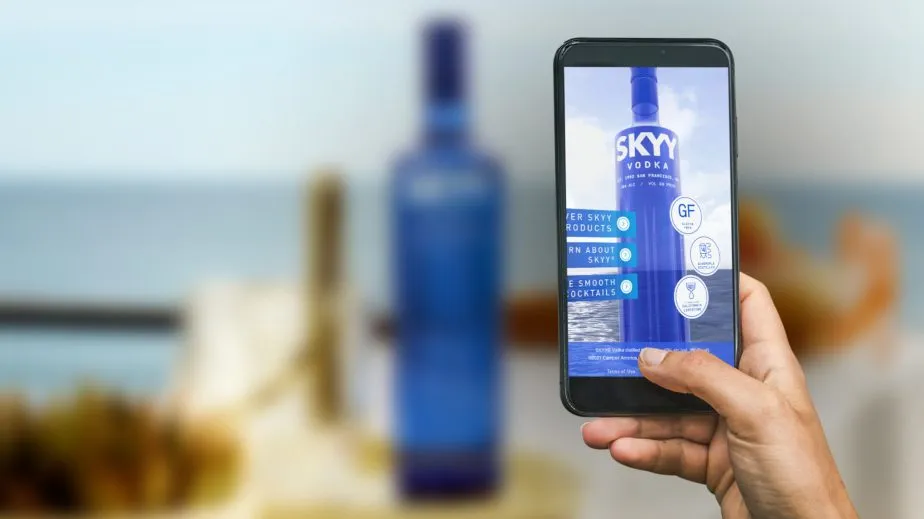
More value from "Throwaway" POS: Brands now have a smart alternative to bulky, plastic-heavy in-store point of sale displays with QR-activated AR experiences. This reduces physical production waste and simplifies retail resets. Blippar’s Skyy Vodka ‘Pacific Escape’ experience shows how brands can place immersive 3D environments directly into users’ real-world settings.
Radical Transparency: The "Virtual Sustainability Label" allows users to scan a product and see its journey from carbon footprint to ethical standards turning sustainability into a verifiable interactive experience.
Skyy Vodka Pacific Escape AR Experience
The Evolving Landscape: What to expect in 2026
As we move through 2026, the AR ecosystem is maturing through two primary hardware shifts:
AI Integration: AI is now the brain behind the AR visuals. It allows experiences to be personalised in real-time based on user intent and environment, making AR ads feel less like a broadcast and more like a helpful, intuitive service.
“It’s not just the technology that’s evolving,” says Blippar CMO Lloyd Jennings.
“When brands build AR experiences that encourage people to compete, customise, and share, they create something far more powerful than a one-off interaction. These experiences invite repeat engagement, bring other people into the brand story, and continue delivering value long after launch unlike traditional ad formats, which can quickly lose impact.”
Frequently Asked Questions
Is AR advertising expensive? WebAR has significantly reduced barriers. Many brands now measure ROI based on engagement quality rather than just raw reach.
Is AR only for large brands? No. Modular tools like Blippbuilder with transparent pricing and WebAR have made immersive tech accessible to mid-sized and challenger brands.
Does it work for B2B? Absolutely. There is no better way to demonstrate complex industrial machinery than through a full-scale AR demo on a factory floor.
Driving Engagement & Increasing Conversions
Blippar Studios helps brands build experiences that don't just get impressions, they get results.
We’ve worked on 30,000+ AR campaigns with world-leading brands.
Our unique technical and creative experience means we deliver bespoke, results-driven campaigns with immersive experiences that truly connect with your customer.