


Choosing the right WebAR platform is one of the most important technical decisions an agency can make. Get it right, and you have a scalable production engine that can deliver campaign after campaign for your clients. Get it wrong, and you’re rebuilding from scratch every time.
In 2026, the landscape has shifted significantly. 8th Wall, long the go-to choice for developer-led agencies, has shut down its platform. That’s left a generation of AR-capable agencies re-evaluating their stack.
This guide compares the best WebAR platforms for agencies right now, with a focus on the factors that actually matter in a production environment: workflow, pricing, flexibility, and client delivery.
What agencies actually need from a WebAR platform
Consumer-facing demos don’t tell you much about what it’s like to run an agency on a platform. Here are the criteria that matter most in a professional context:
- Multi-client management: Can you manage multiple client accounts, projects, and brands from a single dashboard?
- White-label capabilities: Can you deliver experiences under your own or your client’s branding, without platform watermarks?
- Workflow and collaboration: Does the platform support team access, review workflows, and approvals?
- Tracking quality: Does image tracking, surface tracking, and face tracking perform reliably across a range of real-world lighting conditions and device types?
- Pricing model: Is the pricing structure viable at scale? Volume-based, per-project, or flat monthly?
- SDK availability: If your team codes, is there a developer SDK with good framework compatibility?
- Support and SLA: What happens when a campaign has a bug at 7pm on launch day?
With those criteria in mind, here’s how the main platforms stack up.
The 2026 WebAR platform landscape
Blippar: Blippbuilder + WebAR SDK
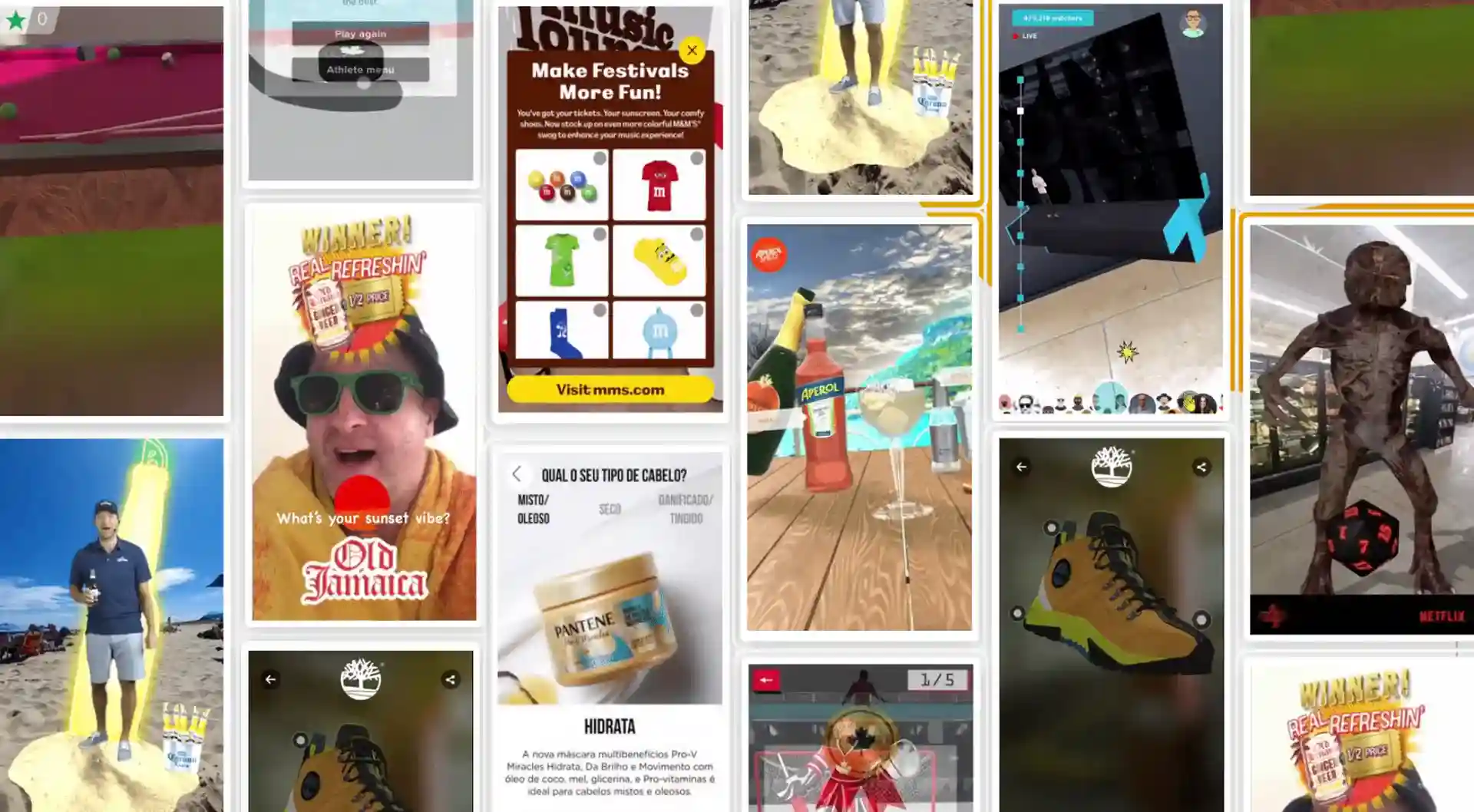
Blippar is one of the longest-established names in WebAR, and its current product set is the broadest in the market: Blippbuilder for no-code campaign creation, a full-featured WebAR SDK for custom development, and Blippar Studio for managed campaign delivery.

For agencies, Blippbuilder is particularly well-suited to teams that need to spin up a high volume of client experiences quickly. The drag-and-drop interface covers the majority of standard campaign types including image-tracked product experiences, face filters, surface-placed 3D objects and more. The platform also supports Microsoft Teams integration for collaborative review and approval workflows.
The WebAR SDK sits alongside Blippbuilder for technical teams and is compatible with Unity, PlayCanvas, A-Frame, and Babylon.js. It includes GPU SLAM for 30fps mobile AR rendering, plus real-time face, surface, and image tracking, the core technical requirements for most agency campaigns.
For agencies managing multiple clients, Blippar’s Enterprise plan includes dedicated support, custom analytics, and no-watermark publishing.
Zappar: ZapWorks
ZapWorks, developed by Zappar, is a mature platform that combines a visual designer with a developer-focused SDK. It supports image, world, and face tracking, and includes a WebAR embed tool for integrating AR into existing websites. It’s a popular choice for mid-size agencies and education sector clients. Paid plans start at around $58/month.
Where ZapWorks differs from Blippbuilder is in its code-first orientation. The platform is arguably stronger for developer-led teams than for no-code creators, though the visual designer has improved significantly. For agencies who already compared the two, our guide provides a detailed side-by-side.
For more on how the platforms compare, see: Blippar vs Zappar: Which WebAR SDK & AR Platform Is Right for You?
8th Wall and the post-shutdown landscape
8th Wall was, for several years, the dominant choice for developer-first WebAR. Its combination of robust tracking, comprehensive documentation, and strong developer community made it the default for technically sophisticated agencies. Niantic confirmed that 8th Wall access ended on 28 February 2026, with hosted content available until 28 February 2027.
For agencies currently running 8th Wall experiences, the clock is ticking. The most common migration paths are to Blippar’s WebAR SDK (for developer teams who want equivalent capability) or to Blippbuilder (for teams who want to simplify their production pipeline). For a technical deep-dive on migration, see our practical guide.
See: How to Migrate from 8th Wall: A Practical Guide for AR Creators and Agencies and Blippar vs 8th Wall: Which WebAR Platform Should You Choose in 2026?
Other platforms worth knowing
Hololink offers a browser-based no-code editor with a strong drag-and-drop interface, well-suited to teams building simple experiences without developer support. AR Code provides QR-triggered AR for SMBs and quick deploys, but lacks the depth required for complex agency campaigns. Neither matches Blippar’s combination of no-code accessibility and developer SDK depth.
Platform comparison: key criteria for agencies
| Platform | Pricing | Approach | Agency Workflow | Best For |
| Blippar (Blippbuilder + SDK) | Free–Enterprise | No-code + dev SDK | ✅ Strong | Agencies, enterprise brands |
| Zappar (ZapWorks) | From $58/month | Visual designer + SDK | ✅ Strong | Mid-size agencies, education |
| 8th Wall | Shutting down Feb 2026 | Developer-first SDK | ⚠️ Migrating | Developers migrating now |
| Hololink | Free–paid tiers | No-code web-based | ⚪ Limited | Simple experiences, no-code teams |
| AR Code | Free–paid tiers | QR-linked AR | ⚪ Limited | SMBs, quick deploys |
Which platform is right for your agency?
There’s no universal answer, but some useful rules of thumb:
- If your team is primarily non-technical and you need to produce a high volume of client experiences quickly, Blippbuilder is likely the best fit. The free tier lets you evaluate it without commitment.
- If you have in-house developers and need full creative control and custom integrations, the Blippar WebAR SDK gives you the same technical depth as 8th Wall at a more accessible price point.
- If you’re an 8th Wall shop looking for the fastest, lowest-friction migration path, the Blippar WebAR SDK is specifically designed to be compatible with your existing workflow.
- If you’re currently on Zappar and considering alternatives, the head-to-head comparison guide covers the specific differences in SDK architecture, pricing, and tracking capabilities.
Getting started with Blippar for your agency
The quickest way to evaluate Blippbuilder for agency use is to sign up free and build a test experience. No payment details are required to explore the platform, and the drag-and-drop interface means most teams can produce a working experience within a few hours.
For developer-led teams, the WebAR SDK is free to download with a 100-view trial included which is enough to test tracking, performance, and framework compatibility before committing to a subscription.
For agencies considering Blippar Studio for managed campaign delivery, the team can provide scoping consultations and indicative pricing based on campaign brief.
Ready to evaluate Blippar for your agency? Try Blippbuilder free or download the WebAR SDK. No payment details are required.
For managed campaign support, contact the Blippar Studio team.
Sources & further reading
Top 10 Alternatives After 8th Wall’s 2026 Shutdown — Kivicube
Best Web-Based Augmented Reality Platforms 2025 — Overly
Zappar vs Blippar Review — Designium
8th Wall Shutdown: Timeline, Impact and Best Alternative — AR Code