

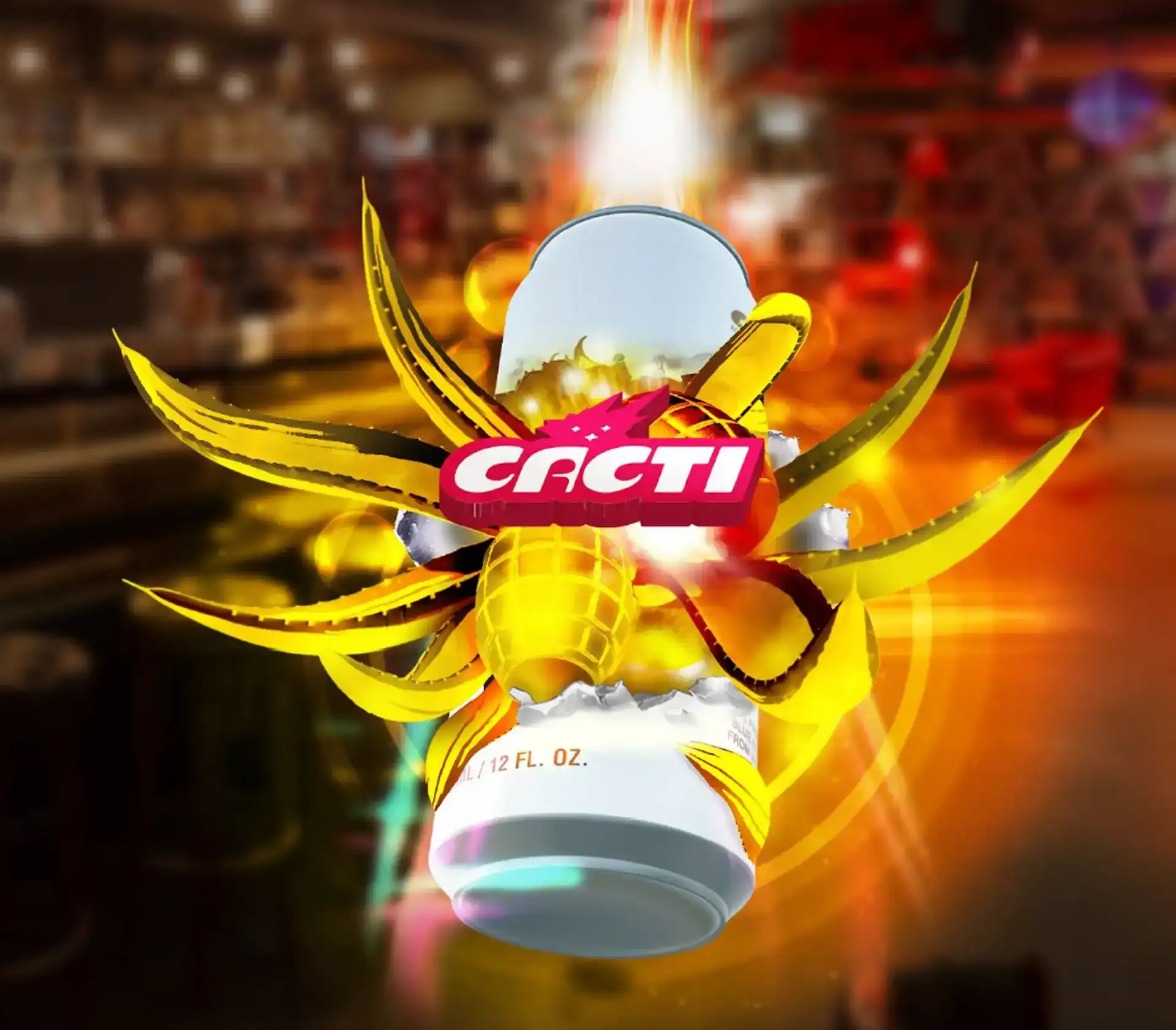
Your packaging is in front of your customer for thirty seconds, two minutes, or sometimes years, sitting on a shelf, in their kitchen, or in their gym bag. For most FMCG brands, that physical presence has always been a static media channel: a logo, a hero shot, some on-pack copy. WebAR changes that.
With a QR code and a smartphone camera, a can of soft drink becomes a jukebox. A ketchup bottle becomes a recipe book. A cereal box becomes a game. And none of it requires an app download, just a tap and a browser.
This guide examines how leading FMCG brands are deploying WebAR on packaging in 2026: the campaign formats, the results, the technical considerations, and the practical steps to get started.
Why packaging has become the biggest opportunity in FMCG AR
The shift from app-based AR to WebAR has been transformative for packaging activations. Previously, brands faced a fundamental UX problem. Asking a consumer to download an app to interact with packaging was a conversion-killer. Most consumers simply wouldn’t bother.
WebAR removes the barrier entirely. A QR code printed on any pack launches an AR experience directly in the phone’s browser. No app, no friction, no delay.
The result is that brands who failed to reach meaningful engagement rates with app-based AR in 2019 are seeing dramatically different results with WebAR today.
96% of FMCG brand managers plan to increase connected packaging investment in 2025 – 2026, up from 59% in 2022 (Appetite Creative, 2024).
48.5% engagement rate achieved in a Blippar WebAR campaign for Magnum Singapore, 34x higher than industry average.
There’s also a structural argument: packaging is the only brand touchpoint that reaches 100% of purchasers. Social, search, and display all operate on probabilistic reach. Every consumer who buys the product sees the pack. WebAR turns that universal touchpoint into an interactive channel.
4 ways FMCG brands are using WebAR on packaging
1. Recipe content and ingredient storytelling
Heinz was among the first FMCG brands to prove this format. Their 2011 AR packaging campaign printed on-pack triggers that launched a visualised recipe book, with recipes built around Heinz Ketchup as an ingredient. The campaign generated over 570,000 global scans which is exceptional for early AR technology with considerably higher friction than today’s WebAR.
In 2026, the same concept is significantly more powerful. Brands can launch WebAR recipe content via a simple QR code scan, embedding the experience in the mobile browser rather than requiring the Blippar app. Seasonal recipes can be swapped in and out without reprinting packaging. The QR code stays the same, but the content behind it updates.
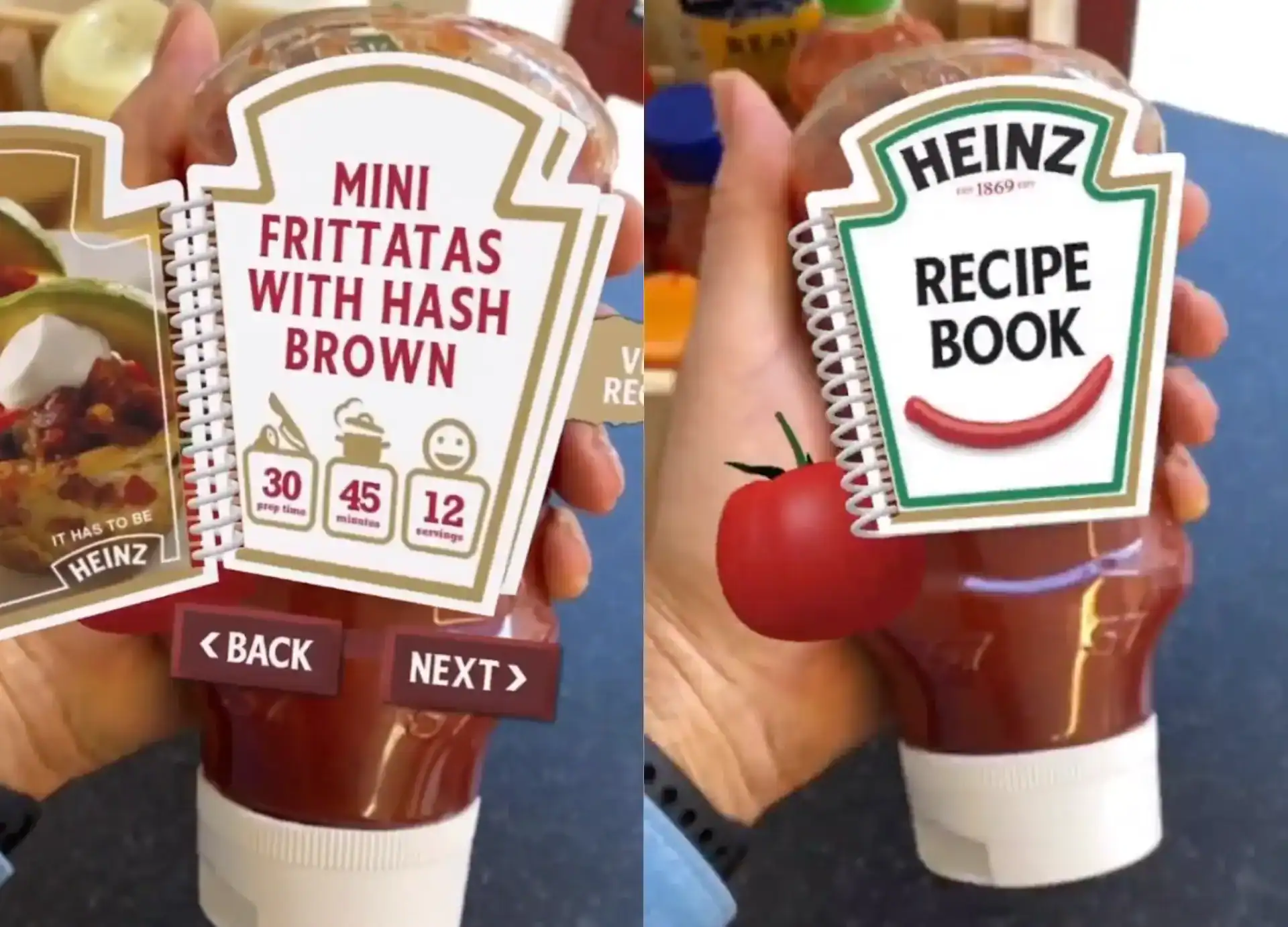
This AR packaging campaign for Heinz ketchup uses on-pack triggers to launch a visualised recipe book.
For example, Heinz can use the same on-pack QR code year-round while rotating seasonal recipe content, featuring summer BBQ recipes in July and comfort food recipes in November, without any need for packaging reprints.
2. Interactive games and seasonal campaigns
Cadbury’s 2011 partnership with Blippar produced a WebAR game called Qwak Smack, in which cartoon ducks appeared out of the packaging for users to tap and win prizes. The format proved what has since become a well-established pattern. Gamification on packaging drives repeat engagement, encourages social sharing, and extends the brand interaction well beyond the point of purchase.
Lucky Charms has taken a similar approach, building a gaming experience around on-pack triggers. Quaker created a selfie experience featuring their brand mascot, Larry. In both cases, the mechanism is simple. The packaging is the game board, and the phone is the controller.
For FMCG brands, the game format is particularly effective for limited-edition lines, promotional periods, and seasonal campaigns where the novelty of the experience matches the time-limited nature of the product.
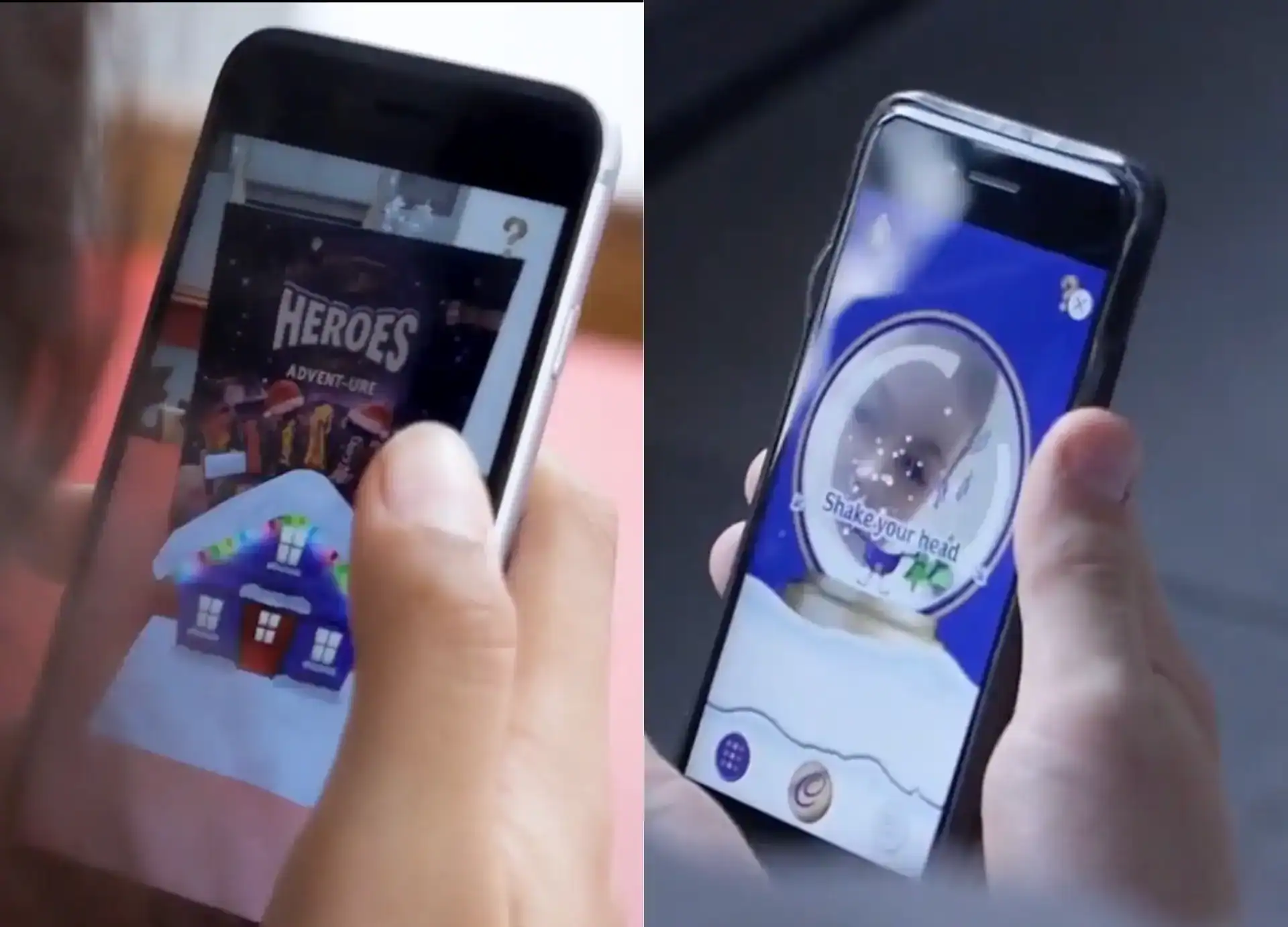
Cadbury Heroes used Blippar to gamify their holiday packaging, turning each pack into an interactive experience that encouraged scanning, gameplay, and social sharing, driving deeper engagement and extending brand interaction beyond purchase.
3. Entertainment and brand world experiences
Coca-Cola’s collaboration with Blippar turned 250ml cans into interactive Spotify jukeboxes. Scanning the can with the Blippar app launched a browser-based interface showing the UK Top 50 tracks in real time. The experience transformed a passive packaging moment (picking up a can at a shop) into an active brand interaction with a relevant utility: music discovery.
The entertainment format is particularly effective for brands with strong cultural associations, music, sport, gaming and fashion for example, because it lets the brand extend its territory into the consumer’s world rather than the other way around.
A can of Coca-Cola with access to your favourite music is a meaningfully different object than one without.
In 2026, equivalent experiences can be delivered entirely in the mobile browser, without requiring any proprietary app. The consumer scans a QR code, and the experience launches immediately.
4. Product transparency and trust building
Beyond entertainment, a growing number of FMCG brands are using WebAR packaging to deliver functional information: provenance data, ingredient sourcing, sustainability credentials, and product authentication.
This is particularly relevant in food and beverage, where consumer demand for transparency has driven significant investment in connected packaging.
The mechanism is straightforward. A QR code on pack triggers a WebAR experience that surfaces origin information, certification data, or a farm-to-shelf journey. In some implementations, the AR overlay appears directly on the product itself, making the information feel spatial and connected to the physical object.
- A coffee brand uses AR packaging to show the exact farm where the beans were grown, with video content from the farmer.
- A global footwear brand uses AR to invite viewers to experience the launch of their Greenstride collection highlighting its sustainability credentials.
- A spirits brand uses AR to display authentication verification, allowing consumers to confirm they have a genuine bottle.
- An FMCG manufacturer uses AR to surface up-to-date allergen and nutritional information that can be updated without reprinting packaging.
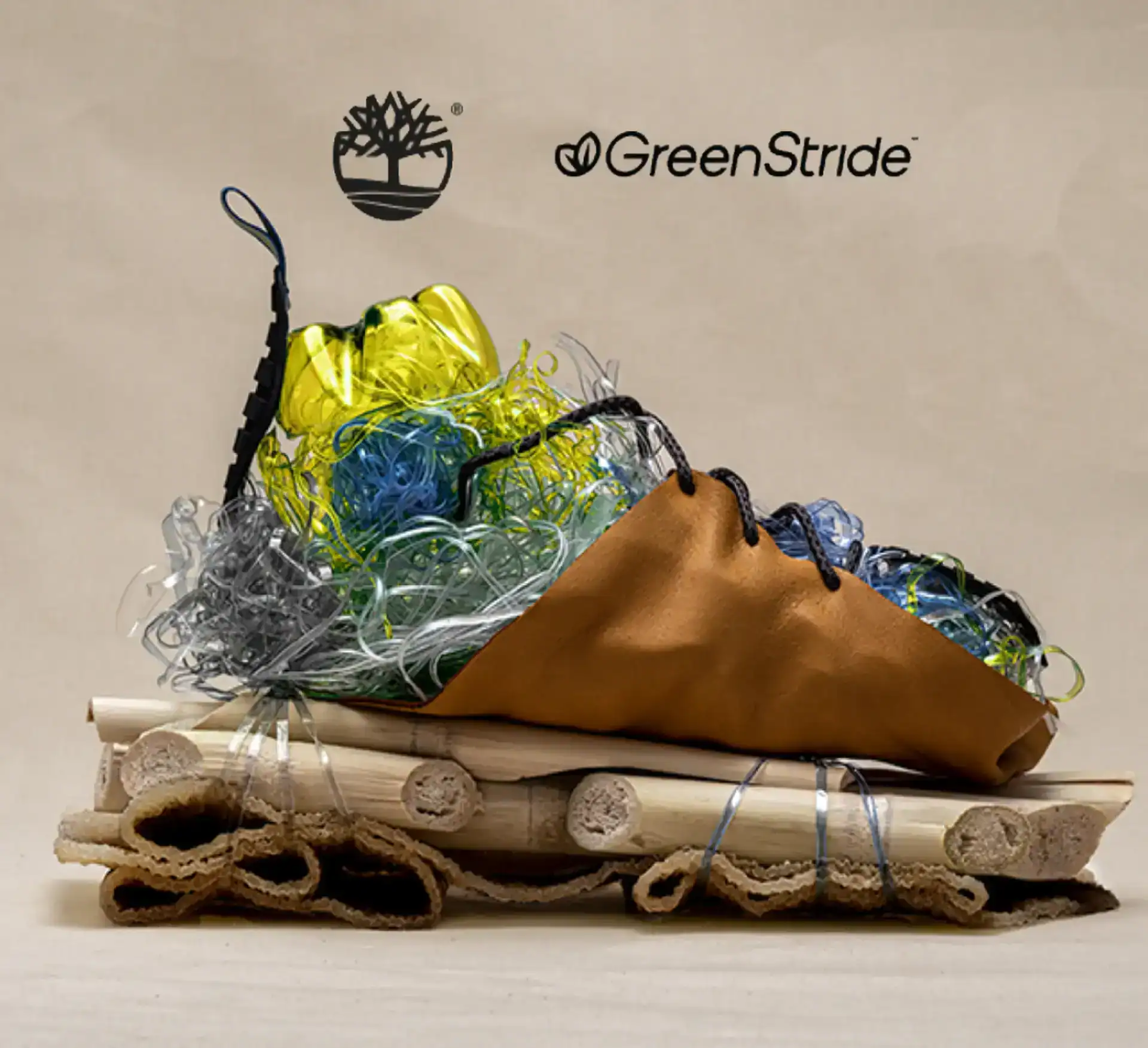
A global footwear brand used Blippar AR to bring its ‘Greenstride’ collection to life, allowing consumers to explore the product’s sustainable materials and design through an interactive experience, reinforcing its sustainability credentials and deepening engagement at launch.
What results can you expect?
Industry benchmarks for WebAR packaging campaigns vary significantly depending on experience type, brand awareness, and pack prominence.
However, consistently observed patterns include:
- WebAR experiences generate dwell times 4–5x longer than standard digital display advertising.
- Engagement rates for gamified experiences regularly exceed 30%, versus 0.1-0.3% for typical display ads.
- Repeat scan rates. Users who return to the same experience more than once are significantly higher for content that updates seasonally or offers progressive unlocks.
- QR-triggered WebAR consistently outperforms app-required AR in scan rates, due to reduced friction.
Technical considerations for AR packaging
Deploying WebAR on packaging doesn’t require a technical team on the brand side, but there are several practical decisions that shape what’s achievable:
QR code vs image tracking
Most AR packaging activations use a QR code as the trigger. The consumer scans the code, which opens a URL in the mobile browser that launches the WebAR experience. This is the simplest and most reliable deployment approach and works with any modern smartphone.
As an alternative to launching via QR, image tracking (where the AR experience is anchored to and overlaid on the packaging itself) creates a more immersive effect, but requires the consumer to know to point their camera at the pack. For most FMCG applications, QR-triggered experiences deliver better scan rates.
Content updates without reprinting
One of the most commercially significant advantages of WebAR packaging is content flexibility.
Because the AR experience lives at a URL (not in an app), the content can be updated at any time without reprinting the packaging. A single QR code can serve different content to different markets, at different times of year, or for different promotional periods.
Analytics and attribution
Blippar’s platform includes campaign analytics that capture scan volume, engagement rates, session duration, user location, and device data. For FMCG brands, this provides data on packaging performance that has historically been very difficult to measure, giving marketing teams insight into which SKUs, markets, or time periods are driving the most engagement.
How to get started with WebAR packaging
The barrier to entry for WebAR packaging is lower than most brands assume. You don’t need to redesign your packaging. A QR code can be added to the next print run, or even to a sticker or insert for market testing. Here’s a practical starting path:
- Define your objective first: entertainment, education, transparency, or conversion. The objective shapes the experience format.
- Audit your existing assets: do you have 3D product models, brand characters, or video content that could be repurposed? Reusing existing assets significantly reduces production cost.
- Decide on your build approach: Blippbuilder for a no-code, self-managed experience, or Blippar Studio for a fully managed campaign with dedicated creative and technical support.
- Test before committing to a full packaging run: build the experience and test it thoroughly on real devices across iOS and Android before printing QR codes at scale.• Plan for content updates: build your initial experience with future seasons and promotions in mind so content can evolve without reprinting.
Ready to add WebAR to your packaging? Book a discovery call with Blippar Studios and see how we can build your AR experience
Sources & Further Reading
How Web AR Drove Footfall & Sales to Magnum’s Retail Store — Blippar
Interactive Packaging Market 2025 — GlobeNewswire
Smart Packaging Trends Reshaping FMCG in 2026 — Hovarlay
7 Applications of AR in FMCG — Aircards
Blippar and Packaging: The Reality and Possibilities of Digital Engagement — Packaging Digest